
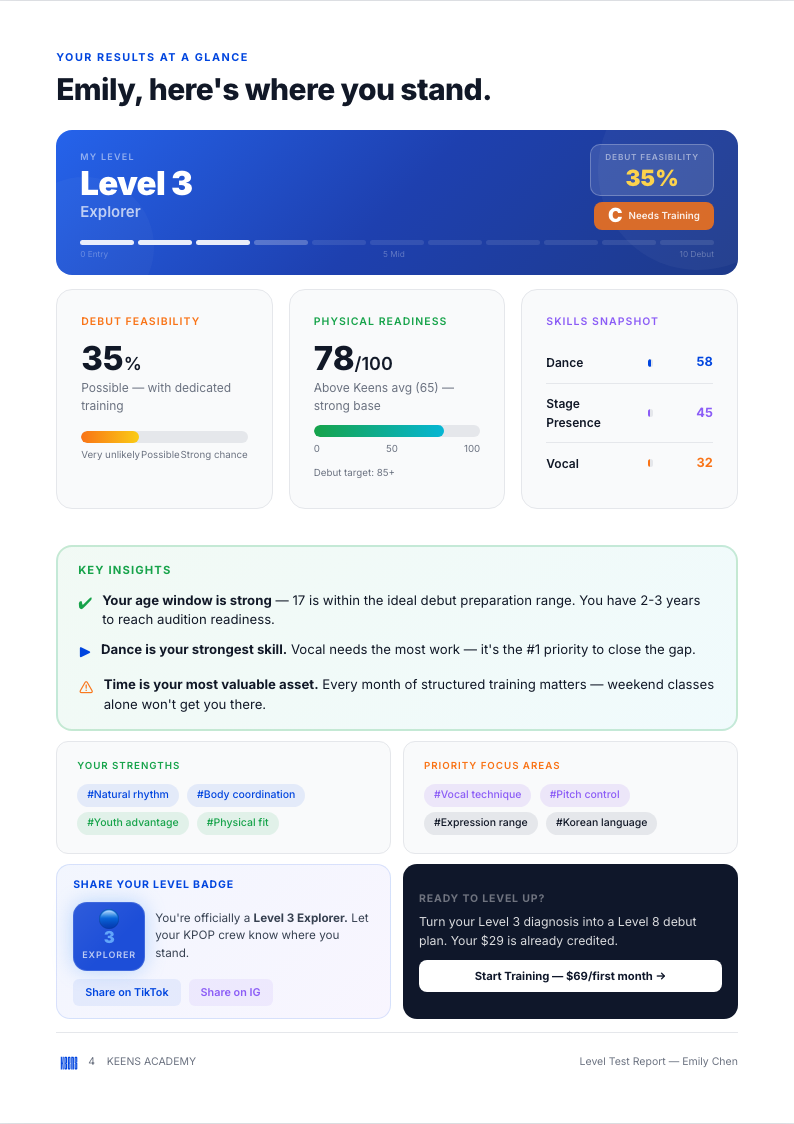
Short answer: K-pop training cost is a ladder, not a single price. The usual path runs free self-practice, then a low-ticket online plan you can cancel monthly, then an academy or hagwon, then a Seoul intensive. You do not have to buy the top step. A Level Check shows which step you actually need. Current Keens training is K-TOP online training.
The cost ladder
- Free self-practice. YouTube tutorials, cover videos, and practice apps. Useful for motivation and for learning choreography. Nobody corrects you, so mistakes can harden into habits.
- Low-ticket online. A structured curriculum you follow from home, billed monthly and cancelable anytime. This is the step most people use once free practice stops being enough. Compare options in Best Online K-pop Training Programs [2026].
- Academy or hagwon. Local classes, or a fuller academy with regular correction on your footage. Quality varies — ask who teaches and whether someone reviews your clips. Personal correction sits higher on the ladder because it takes a trainer's time.
- Seoul intensive. Full studio days, live correction, and professional footage. Lodging is often included; flights, meals, and visa costs usually are not. Best once your foundations are already solid. See Summer Intensive Seoul.
What moves you up the ladder
- Evaluation. A scored read tells you which step to spend on.
- Curriculum. A sequence across dance, vocal, expression, and stage is more useful than a single class.
- Personal correction. Feedback on your footage is the step that usually costs more, because it takes a trainer's time.
- Location. Training in Seoul adds travel and time away from home.
- Duration. A month and a year are different commitments. Month-to-month plans keep the risk lower.
The expensive mistake: training without a baseline
The real cost is often time spent practicing the wrong thing — a year of harder choreography when the gap was rhythm, or months of high notes when the gap was breath support.
A baseline evaluation is the cheapest insurance against that. It tells you whether you need foundations, structured training, personal coaching, or a Seoul intensive.
How Keens maps onto the ladder
Keens splits training into four stages so you can start low and move up only when it makes sense:
| Stage | What it is | Who it's for |
|---|---|---|
| 1. Level Check | 0–10 score, written notes, roadmap (video or no-video option) | Everyone, before committing |
| 2. K-TOP online training | 350+ lessons, practice tools, and an Audition Field Guide; monthly, cancel anytime | Trainees ready for structure |
| 3. K-TOP 1:1 | K-TOP plus weekly coach feedback and monthly score | Trainees who want faster correction |
| 4. Summer Intensive Seoul | 14 days on the Keens Seoul floor, lodging, filmed performance | Trained students ready for studio pace |
See K-TOP online training. Refund terms are listed on each product page.
How to judge whether a program is worth it
Ask:
- Who built the curriculum, and who gives feedback?
- Will someone review my footage, or is it video-only?
- Is there a scored evaluation so I can see progress?
- Can I start month-to-month?
- Does it promise a debut? (If yes, that's a reason to leave.)
Keens' system was built by Jae Shim, who spent twenty years as Performance Director at SM Entertainment, and has trained 15,000+ trainees globally. It sells training and evaluation — never an audition or debut.
Do agency trainees pay for training?
Inside a legitimate agency trainee system, trainees generally don't pay tuition to the agency; the company invests in development and the contract defines what happens next. Paying anyone for a "guaranteed" trainee spot is a red flag.
Spend on the right step. Start with a Level Check, then K-TOP online training.
FAQ
How much does K-pop training cost?+
Think of it as a ladder: free self-practice, then a low-ticket online plan you can cancel monthly, then an academy or hagwon, then a Seoul intensive. Lodging is often included in a Seoul camp; flights, meals, and visa costs usually are not. Keens lists K-TOP online training at https://www.keensacademy.com/#stage-2.
Is online K-pop training cheaper than in-person?+
Online usually sits lower on the ladder, because there is no travel or lodging. Online training with regular feedback is how most international trainees build foundations before a Seoul intensive.
What's the cheapest way to start seriously?+
Get a level evaluation first, then choose the one stage you actually need.
Can I cancel K-TOP?+
K-TOP online training is monthly and cancel-anytime. See it at https://www.keensacademy.com/#stage-2.